
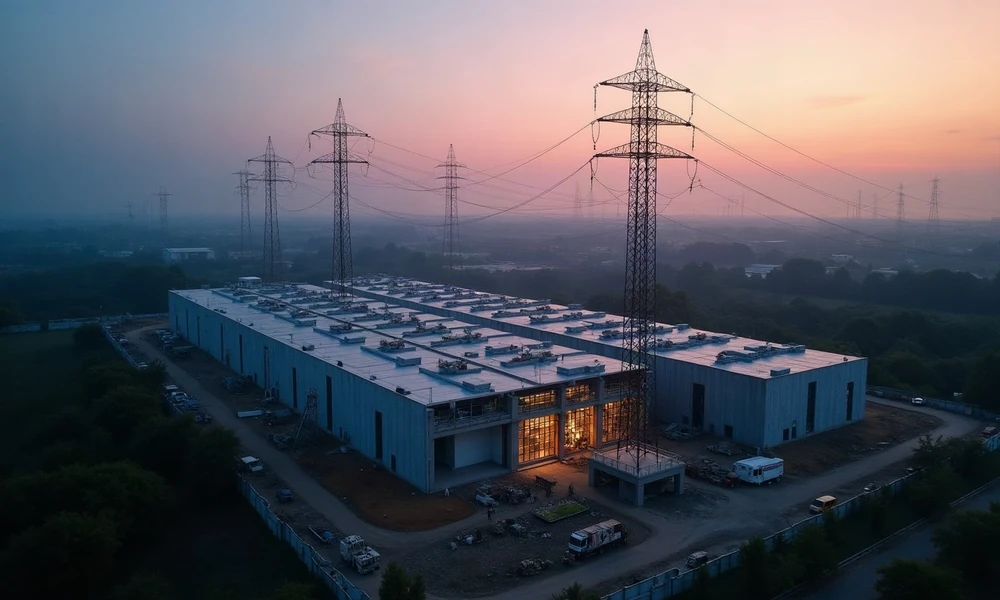
Image Recommendation: An aerial view of a data centre campus under construction at dusk, with transmission towers visible in the background.
Singapore lifted its moratorium on new data centre capacity back in 2022, but lifting it isn’t the same as opening the floodgates. Capacity is allocated under a competitive process tied to energy efficiency and land use, not granted on request, which means the amount of new capacity actually coming online in any given year is deliberately rationed. For a technology company planning several years, that rationing changes where the next build actually makes sense.
Singapore’s Capacity Didn’t Disappear, It Became Harder to Get
A data centre in Singapore still carries advantages that are difficult to replicate elsewhere in the region: dense subsea cable connectivity, low network latency to the rest of Southeast Asia, and a regulatory environment that’s well understood by operators who’ve built here before. What’s changed isn’t the appeal of the location; it’s the pace at which new capacity can be added to meet it. Land is limited, and the government’s efficiency requirements mean every new build has to clear a higher bar than it did a decade ago.
That bar isn’t arbitrary. Allocation decisions weigh power-use efficiency, water use, and how a proposed facility fits into the broader grid plan, so an operator can’t simply buy land and start building on its own schedule as it might have a decade ago. The practical effect is a queue, and a queue is manageable for a facility that genuinely needs to sit inside Singapore for latency reasons, but far less workable for a hyperscale campus that mainly needs raw capacity at a predictable timeline.
Across the Causeway, the Capacity Math Looks Different
A Johor data centre campus doesn’t face the same land or power ceiling, at least not yet, which is part of why Johor has absorbed a large share of the hyperscale capacity that Singapore’s constraints have pushed outward. Proximity matters here too: Johor sits close enough to Singapore that cross-border connectivity can still support latency-sensitive workloads, while offering the physical space and power supply needed for the kind of large, single-site campuses that are harder to build within Singapore’s own footprint.
Sedenak Wasn’t Chosen by Accident
K2’s own Johor campus sits within Sedenak Tech Park, a planned industrial and technology zone with direct access to power infrastructure built specifically to support large-scale development. The site has been developed with a day-ultimate gross power capacity in the order of 300 megawatts, delivered through agreements with Malaysia’s national utility, and an interim supply arrangement was put in place so the campus could begin operating before the full capacity came online. That sequencing, interim power first, full capacity staged in afterwards, is itself a response to how long new transmission infrastructure actually takes to build.
Singapore and Johor Aren’t Solving the Same Problem
| Factor | What tends to drive the decision |
| Land availability | Johor offers larger contiguous sites; Singapore’s are smaller and more contested |
| Power allocation | Singapore rations new grid capacity; Johor has been able to commit larger blocks upfront |
| Latency to Singapore | Johor’s proximity keeps most regional connectivity requirements workable |
| Build timeline | A larger, single-phase campus is often faster to stand up outside Singapore’s constraints |
Renewable Power Is Part of the Infrastructure, Not an Add-On
K2 Strategic’s approach treats renewable energy, solar, wind, and hydro, among them, as a design input rather than a separate sustainability initiative layered on afterwards. That distinction matters for a hyperscale operator, since the power strategy for a 300-megawatt campus has to be settled well before construction starts, not retrofitted once the site is running. Where a renewable source can be tied directly to a campus’s own supply, rather than offset through a separate credit, the environmental case and the capacity case tend to move together instead of competing for the same budget line.
Three Questions Every Site Selection Comes Down To
- Whether enough grid capacity can be committed within the operator’s planning window
- Whether the physical site can accommodate the scale a hyperscale tenant actually needs
- Whether latency to the surrounding region stays within what the workload can tolerate
None of this makes Singapore and Johor competitors in the usual sense; most operators planning at this scale end up needing both, one for latency-critical workloads, the other for the raw capacity that a land-constrained market can no longer provide on its own timeline. The decision isn’t really about picking a winner between the two locations, since each solves a different part of the same infrastructure problem.
Planning a deployment across either market, or both, is a conversation worth having early. Contact K2 Strategic to talk through what the current capacity picture actually allows.

